Monthnotes March & April 2026

Every month or so, I share a quick digest of what I've been working on and reading. Here's the latest. More in the series here.
The music video for my Symphony of Bureaucracy installation is finally edited and complete. I've embedded it in the page on the Loud Numbers website about the project (where you can read a little more context and see some photos of people visiting), but you can see it directly on YouTube here:
Capturing the experience of the installation on film was surprisingly tricky. The audio was recorded in-situ, walking around the piece as it played, to capture how it sounded in the room and represent the way visitors could walk around the installation, but this meant I needed a fair bit of post-processing work to get a useable sound mix.
The video was tricky too. Shooting in a darkened room allowed for maximum visual impact from the lamps flashing on and off, but it made it tricky to handle contrast and get focus correct before a light flashed on. Shooting static electronics, where the only thing moving was lights, made it difficult too.
But despite all that, I think we got to a pretty good place with the final result and I'm happy with what we achieved! Big thanks to Paul Khadra for helping with the audio mix, and Masomenos for working on the video edit.
 0
0
My riso printing experiments have borne fruit. A total of 80 pieces of zine-shaped fruit, to be exact - a zine called "Doing Creative Work in a Climate Crisis" that accompanied a workshop I gave at the end of March at STPLN.
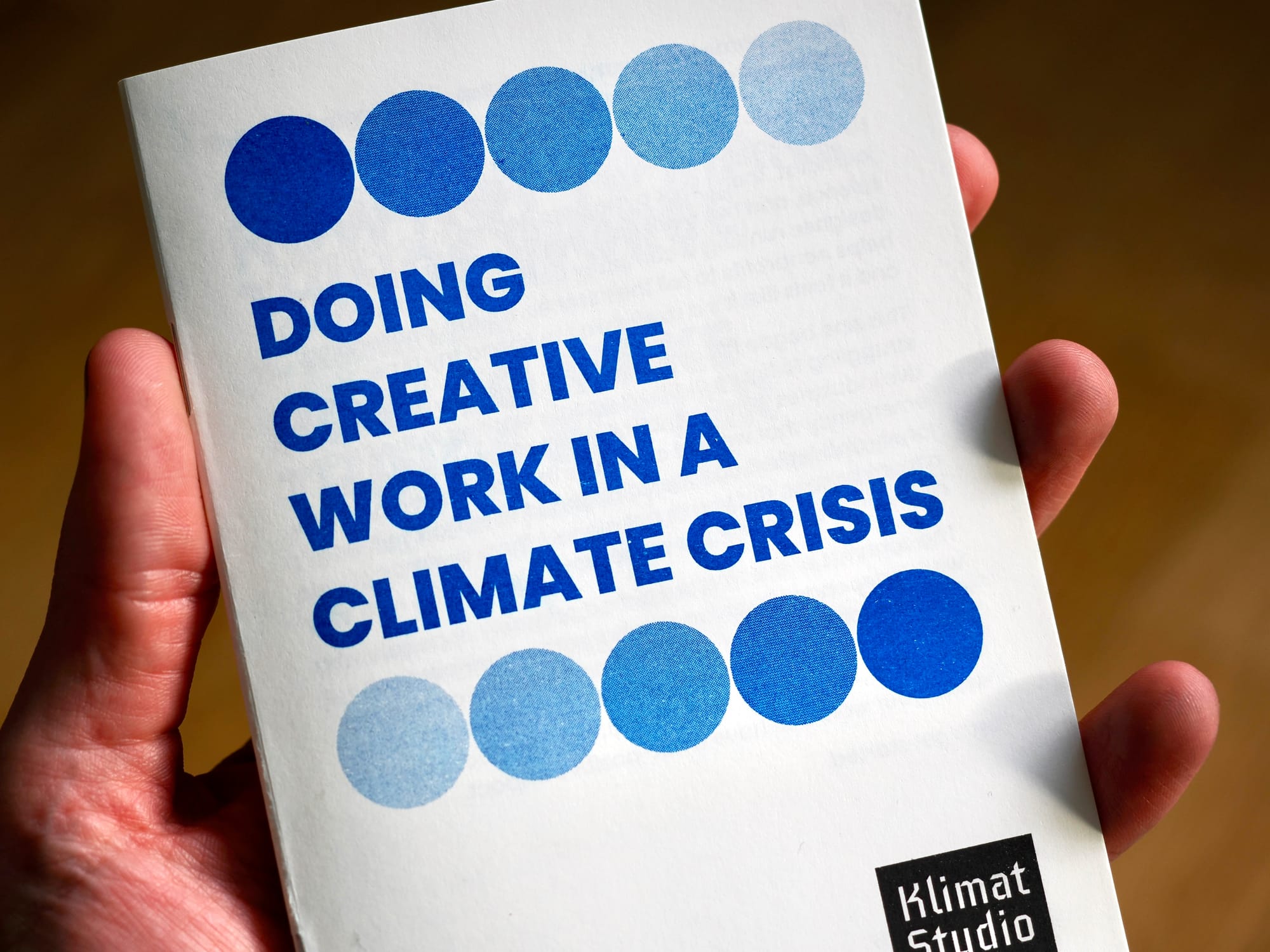
Printing the zine was actually the easiest bit - it took about 90 minutes, with help from the folks at my local riso studio, BEAST. But there was a tonne of work before and after: writing the workshop in the first place, turning the workshop notes into prose of the right length, laying out the zine in Google Docs (first, as a draft), printing it out on my home printer and assembling it to see how it was looking and feeling, then once I was happy re-doing the layout in InDesign (twice, because I didn't do the layer separation right the first time), then exporting the ink layers in greyscale and managing all the files and version control.
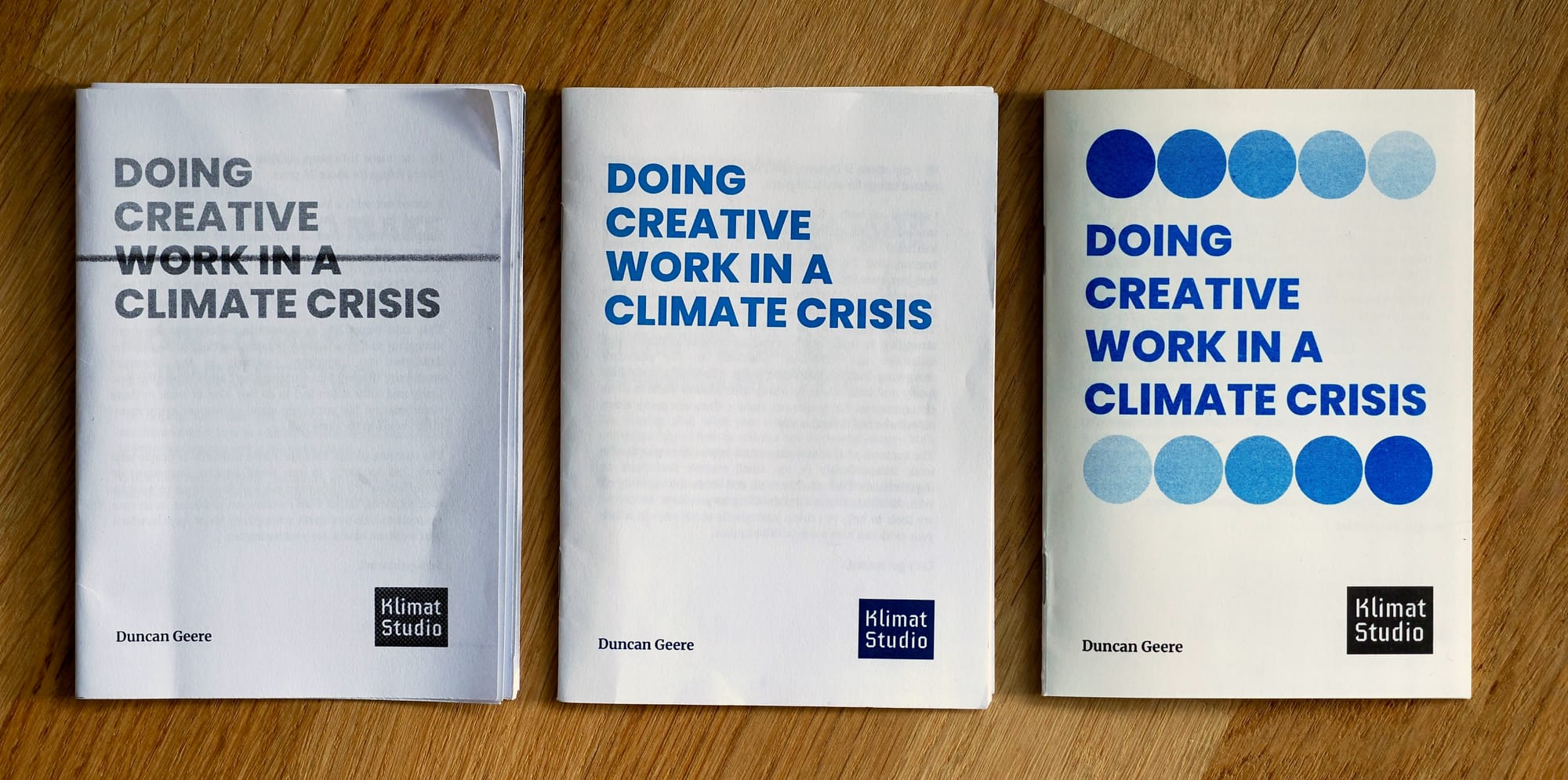
Then printing. Then waiting for the ink to dry for a few days. Then assembling: cutting the A3 prints down to A4, then to A5 (the final zine is made up of A5 sheets folded into A6). Then assembling the cut-up sheets into 80 zines, each with the right pages in the right order. Then creasing the centre (80 times). Then stapling the centre (two staples per zine, 80 times). Then folding and pressing each one (80... you get the idea). Then trimming the right edge of each one. Then trimming the bottom edge of each one. Then finally signing each copy with a pen. Oh, and picking out seven copies to send to the Swedish national archives (they need to have a copy of anything printed, by law) and picking out a nice one to give to BEAST for their own archives.
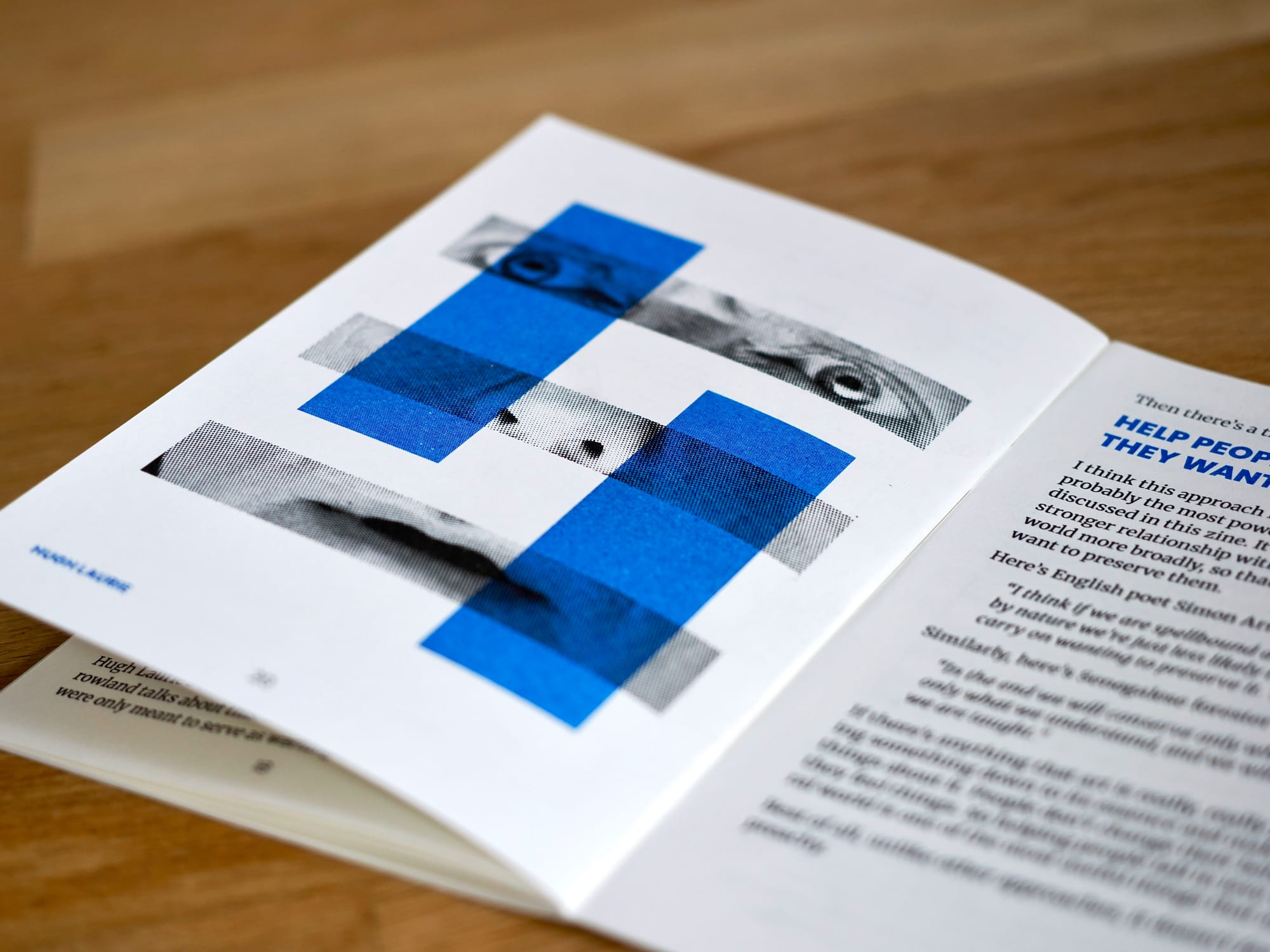
It was an extraordinarily manual process, with lots of repetitive work. But it felt nice. You get in the zone - a place where your hands are doing the work, but your mind is free to chat or think or chill and listen to the sound of the machines. And then occasionally you get a little micropuzzle to solve, like "how many mm should I cut off the bottom edge?" or "how big should the margin be?" or "how far apart should I put my staples?"
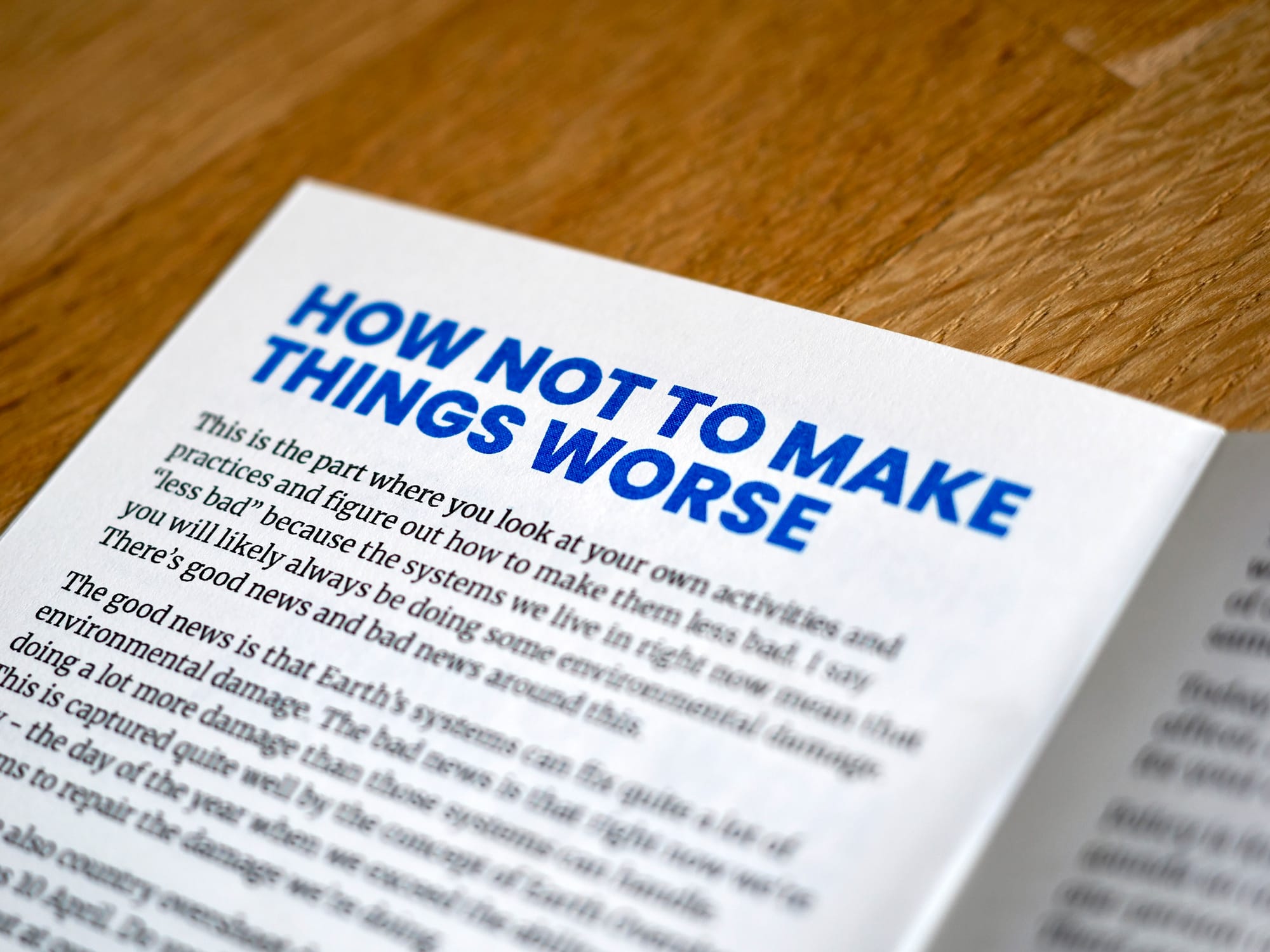
The final product is unquestionably lovely - absolutely worth the effort. It has the gnarl of the physical, as Robin Sloan puts it - riso comes with just the right amount of imperfection. Places where the layers aren't quite aligned on a specific sheet. Places where the riso mask got a little wrinkled and you end up with microfractures spreading across a block of text - still readable, but... gnarly.
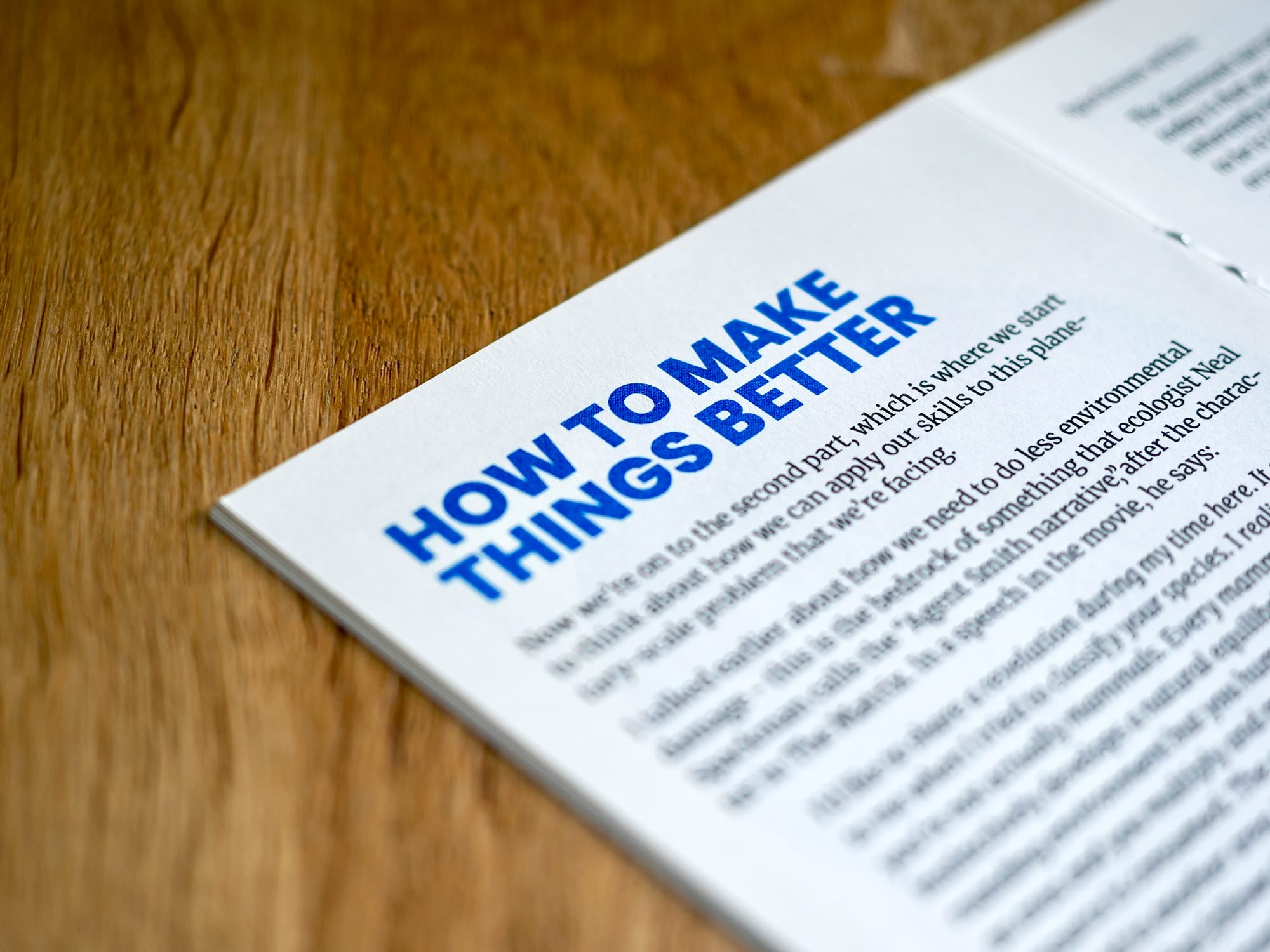
I also learnt a lot. I couldn't have done this without BEAST Studio's help, but next time I'll need a little less help, and be a lot faster and more efficient. Speaking of next time, I have a bunch of ideas that need some development but I'm hoping to get at least some of them done before the summer. I'm interested in doing some posters for an upcoming performance that's mentioned below but I'll write more about next time. I'm interested in doing some cartographic prints. I'm interested in finally doing printed version of my Time for Heroes and Space Dogs posters that I promised about six years ago. I'm working on a Loud Numbers "Create Your First Sonification" zine that's almost finished (more below). And I'm looking for interesting ways to combine riso printing with my pen plotter - thoughts welcome, if you have them, on what might be interesting there.
In the meantime, though, I'm very happy with the Doing Creative Work in a Climate Crisis zine. I thought about building out a little online shop and selling a few of them, but researching cross-border tax and shipping and customs requirements made me lose the will to live, let alone sell zines, so I'm not gonna do that for the time being. If you really really really want one and you're in the EU or UK, then hit reply and we'll find a way to make it work.
Speaking of "Create Your First Sonification", the first Loud Numbers workshop that we ran was a big success, which is nice because we weren't sure that people were going to get it...
Let me explain. The "traditional" way that people tend to do sonification is very technology-centric. It involves CSV files, programming, synthesizers, and it usually sounds like bleeps and bloops. As such, a lot of the learning material out there is geared towards this style of sonification - heavily mediated by technology.
At Loud Numbers, we've always kinda reacted against this and tried to make sonifications that sound like actual music, and express human feelings and emotions about the data used to create that music. This thinking was very much at the core of the Open Sonifications Manifesto that I co-authored a couple of years ago, which highlights a bunch of alternative approaches.
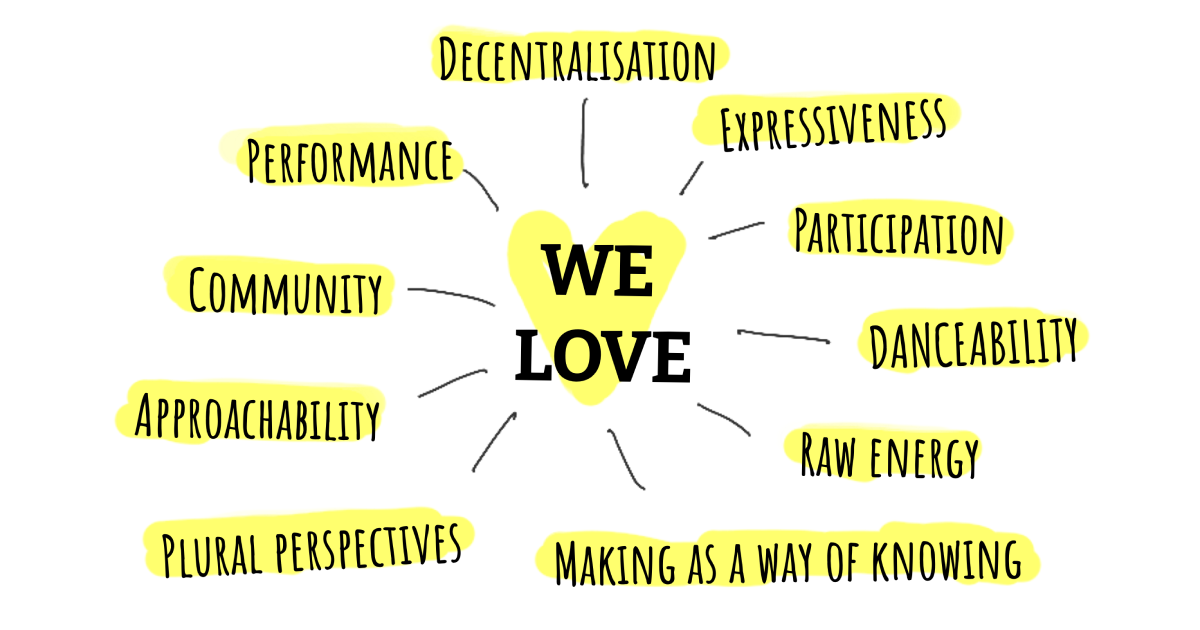
The Create Your First Sonification workshop that we ran was very much built on this approach. Instead of sitting people down and giving them a CSV and asking them to write code to make sound, we get them to collect a tiny personal dataset from their lives and use objects around them (a glass, a whisk, a kid's toy) to represent it in sound. It teaches the principles of sonification, rather than the tools of sonification. Once you understand those principles, you can then apply them in whatever tool you want.
0We've scheduled another beginner workshop date for Saturday 9 May, for which tickets are selling fast, so if the above sounds like fun then please come join us! Later in the year, we plan to do some more advanced courses focused on things like sound design, music theory, storytelling, and more, so if you're interested in that then watch this space.
Somehow, amongst all of that, I found time in the last couple of months to write a little musical waterfall simulator for the new monome iii platform. It's called sluiiice.
 radioedit
monome's norns and grid devices have become central to my musical practice over the last few years - and I've written quite a lot of scripts for those platforms. One of them allows you to turn data into sound. Another creates music that changes based on the current position of the international space station. Another turns the grid into a quantised keyboard, so you never play a wrong note.
The iii platform is a bit different. You have fewer options for user interaction - just an 8x16 grid of buttons that light up. So I made a small script that loosely simulates what happens when you remove a dam from a river, unblocking its flow, simulating fluid running around obstacles and creating music in the process. Here's a quick video of it in action, played by my friend Kotte.
I think the vast majority of people reading this won't have access to a norns, let alone a grid running iii, so you probably won't be able to play with this. Sorry. I guess all I can do is share another video to try to make up for it:
What else is happening? I've almost finished tallying up the results of the Data Sonification Awards 2026, so I'll have some winners to announce next time. I'll also be able to share a project that I've been working on with some friends for the Hubbard Brook Forest Data Jam.
Oh, and when my next newsletter arrives I'll also have just performed an audiovisual concert called "Hadal Excursion" as part of the Dome Dreaming festival at Malmö's "Wisdome" theatre. I'll also say more about next time too, but if you're in the Öresund area then consider grabbing a ticket.

Phew, that's a lot of stuff, so that'll do for today. I'll leave you with two links. The first is an account of a programmer teaching his dog how to vibe code videogames.
Momo types on a Bluetooth keyboard proxied through a Raspberry Pi 5. Keystrokes travel across the network to DogKeyboard, a small Rust app that filters out special keys and forwards the rest to Claude Code. When Momo has typed enough, DogKeyboard triggers a smart pet feeder to dispense treats. A chime tells her when Claude is ready for more input.
Caleb Leak
The second is a comprehensive and heartening look at where battery technology is currently at, courtesy of Bill McKibben.
The huge yellow blob in the middle represents solar generation, the absolutely dominant source of supply from about 8 a.m. to 6:30 p.m. when it drops very quickly to zero. This is a phenomenon called sunset, which used to be the main argument against solar power. But now look at the purple blob to its right—that’s battery storage coming online as the sun goes down. Those batteries spent the afternoon soaking up sunshine—cheap cheap sunshine—and now they’re distributing it back to the grid. This is entirely different from how this graph would have looked even a year or two ago.
 Bill McKibben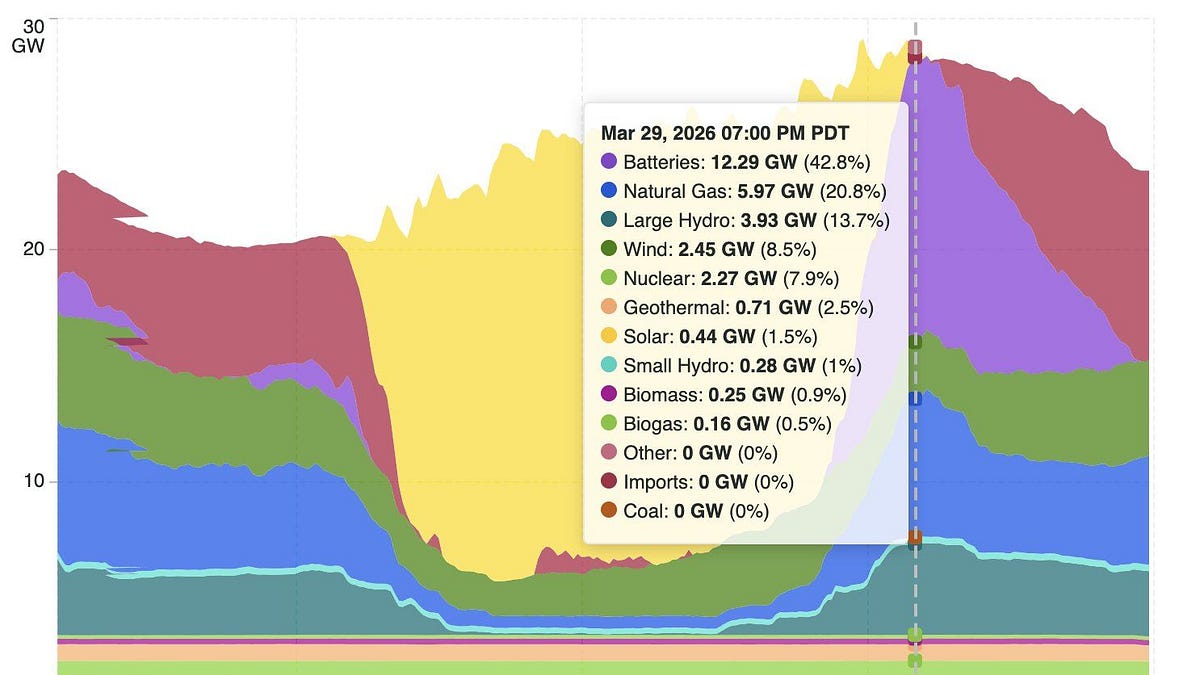
Thanks for reading. I'll be back in your inboxes in mid-May.
Duncan