Monthnotes October 2026

Every month or so, I share a quick digest of what I've been working on and reading. Here's the latest. More in the series here.
Let's start with a big one. Loud Numbers, my data-to-music studio, has a new project out - it's called Financial Symphony and it turns 11 years of business data into a four-minute piece of electroacoustic music for string quartet and electronics. It was made for a company called Sage.
My bit was "electronics" - taking data from South Africa, France and the United States and using it to create a series of pulses that reflect real-time global financial activity. I also recorded a bunch of clicks, taps and knocks in and around my studio, and sequenced them into a percussion track to provide rhythm to the piece without sounding like "drums", a bit like how Icelandic band Múm does on their first few albums (which I love).
We've put together a page on our website where you can hear the music and get more details on how it works. You can also listen to the track on Spotify, or watch the making-of film where you'll get a glimpse into our studios and our creative practice. If you only click one of those links, I'd recommend the making-of film because you get to hear the music and see how it was made all in one. It's only four minutes long.
I did a bunch of radio interviews about this on community stations around the UK, capped off with an appearance on BBC 5Live. It's always super fun chatting to broadcasters about this kind of thing, because they totally understand the mechanics of it but are baffled by the "why would you do this" question. Hopefully I answered that compellingly in the interview!
In the last month I also created an immersive sound and light installation called >BLOOM< for the Sonic Citizens event, here in Malmö. It comprised of a light table, some objects on top, and four speakers that played music which changed as you moved the objects around the table
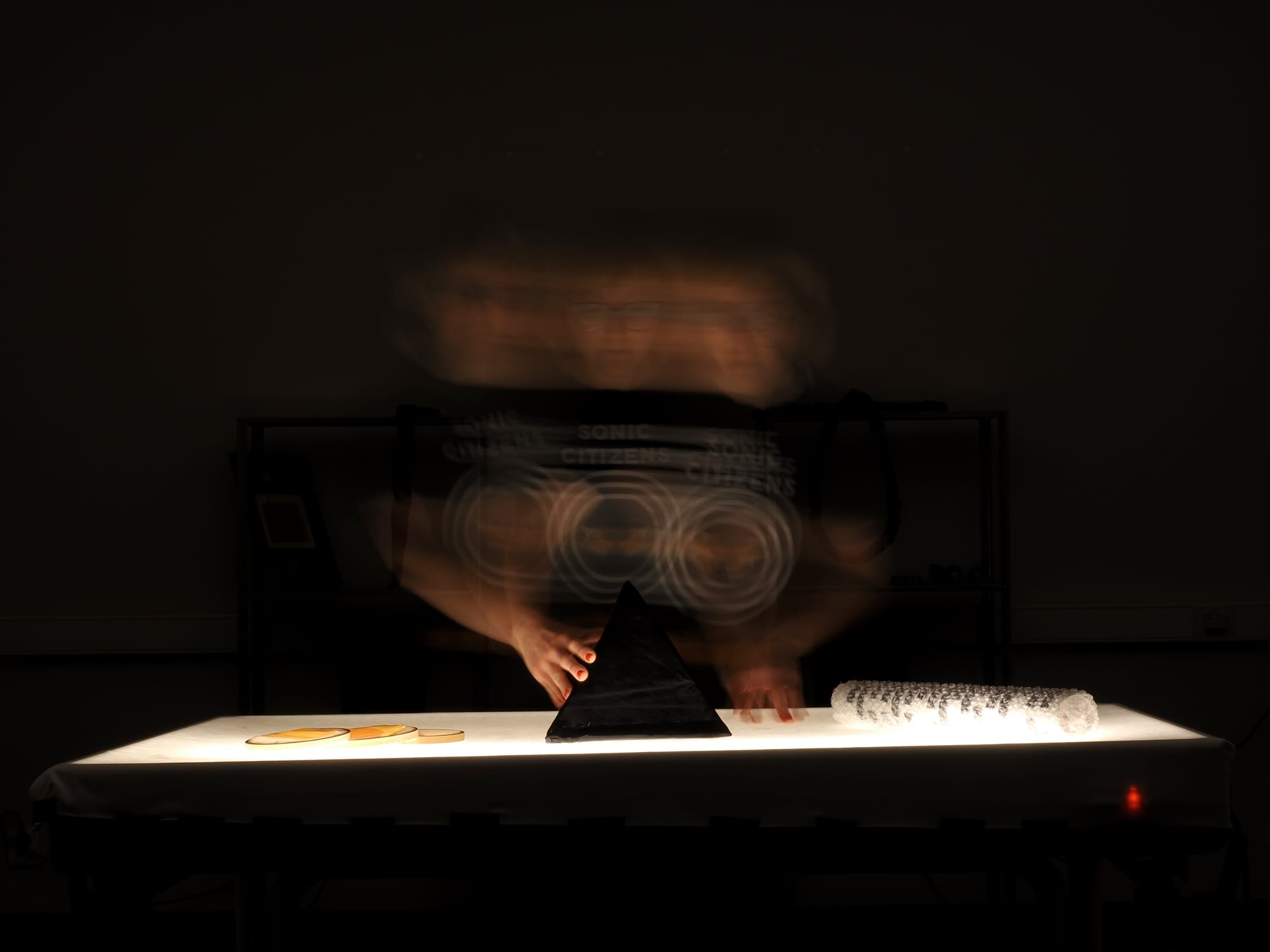
The whole thing was a collaboration between my studio buddies - me, Silfa, Kotte, Konstantine, and Simon. The technical backend was relatively simple - a webcam pointed at the top of the table which was connected to a Mac Mini running TouchDesigner, which did all the image analysis and sent out the results as OSC. A copy of VCV Rack running on the same computer received the OSC signals and turned them into sound. We had two different sound "scenes" which we switched between at different points over the two days that it was open.
I got sick in the run-up to the event (with Covid! In 2026!!) and so I had to put my trust in my collaborators to do a good job, and I wasn't disappointed - the results were really lovely. Really playful and evocative. Spending time with each system and experimenting with it allowed you to start to learn how it worked and responded as the objects on the table (beautifully designed by Silfa) were manipulated. I'll do a full writeup on my blog at some point, but I'm very happy with how it came out.
Here's something nice. The world's oldest national design association, Svensk Form, has named my data sonification studio Loud Numbers as a "Design Icon of the Year" for our work with sonification. Here's what they wrote:
Using sonification as a tool, the duo Duncan Geere (Malmö) and Miriam Quick (Totnes, Devon) create sound-based illustrations that help us gain a deep understanding of large data sets and statistics. Their sound works cover everything from forest fires and nighttime energy consumption to currency trading and the pace of EU legislation. A smart and innovative design that, with its high artistic quality, creates an expression that resonates deeply within you.
The ceremonies for all the people they awarded were distributed across the country, so we had a tiny one in a local sewing shop where I was handed a certificate and some flowers, and got to say a few words. It was very cosy.
In my obligatory LinkedIn bragpost I wrote:
Miriam and I love working with sound because people listen with their emotions. This makes it a really interesting medium to communicate data, which can otherwise be seen as dry, boring, and analytical. We're particularly thrilled that this award comes from a design organisation rather than a data or music one - it shows that people are starting to understand how multidisciplinary sonification is. I don't know whether the people who founded Svensk Form in 1845 could have imagined the kind of work that we do!
The waves of AI spam are starting to arrive at the shores of my inbox. Feels like every other day at the moment I'm getting a sorta-personalised-but-not-really email asking me to check something out or book in a call. It makes me a little bit sad, because sometimes there's at least a spark of something interesting or relevant in the message, and if it was a genuine human message I might actually reply. But all the curiosity in me is vaporised when I suspect it's an agent on the other end.
This phenomenon is mirrored in the flood of sparkly new web apps popping up everywhere. When someone posts about a new tool, my automatic assumption is that it's LLM-coded and my curiosity vanishes. I'm part of this problem of course - the datarates tool that I released last month was largely LLM-coded. I worked hard on the design and user experience of it, which was refined over a period of time, but that's of course what the creators of these things all say.
I think where I'm landing on as a position for my own work, informed by the Robin Sloan post that I linked to last month, is that I'm willing for now to use LLMs to create time-saving tools for use in my own work, but that I'll generally not share those tools with a wider audience, and I certainly won't use LLMs to directly create anything public-facing. With the landscape moving as fast as it is, it's hard to know how long that position will be relevant for, but let's see how it goes.
I've been slowly picking up my pen plotter practice again. After going hard on it in 2020/2021, I bailed when the whole generative art scene was overtaken by NFTs. Now that threat has receded, I've been rediscovering the joy of getting a robot to draw things for you.
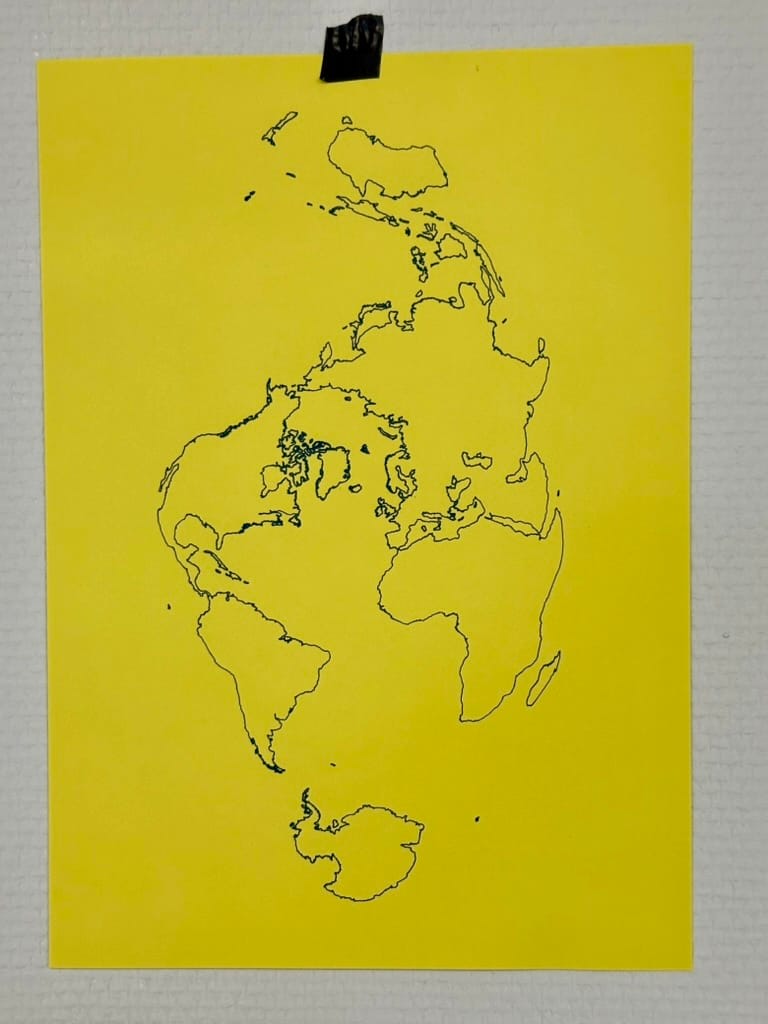
So far I've only done a couple of small experiments. I plotted a vertical version of Hǎo's Projection - a world map that's unusual in the western world, but hangs in most Chinese classrooms. It's just a draft so far, but I think it'd be nice to develop something a bit more complex with this.
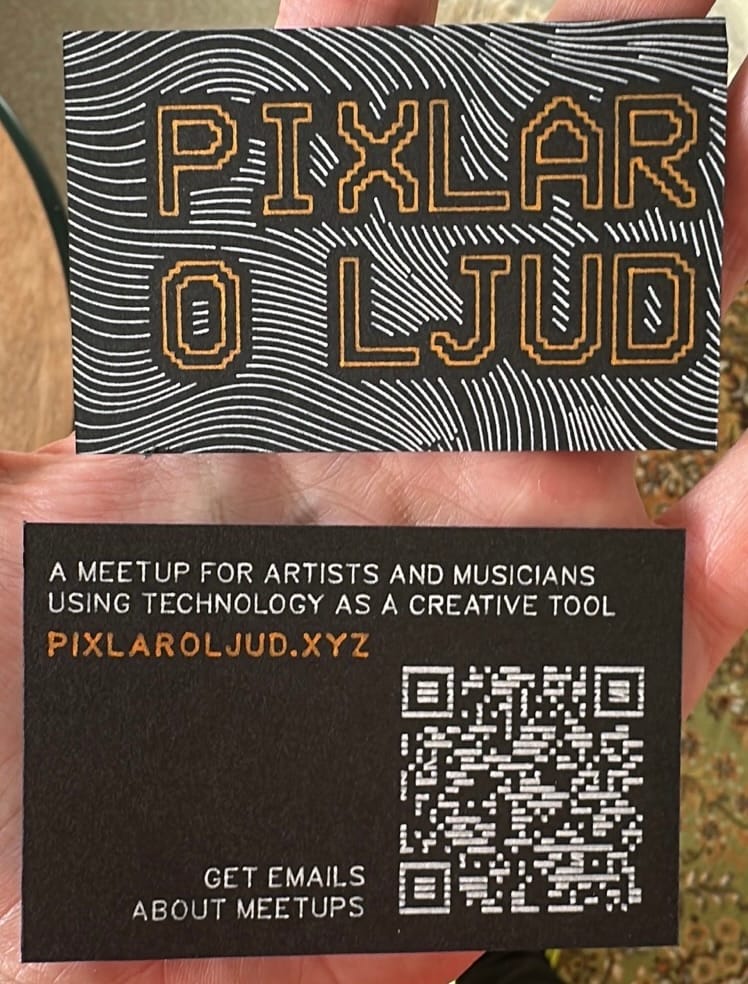
Second, I plotted a bunch of small cards that I can give to people who I think might be interested in attending my Pixlar o Ljud events in Malmö. I often have the problem that I meet folks who would fit right into the community but short of typing something into their phone it's hard to get them to sign up for the emails. I'm hoping that a cool, custom-made, paper card might help.
Finally, I've got a bunch of research done on another (non-plotter) project that I'm hoping will move forward slowly in the coming months - a map or other project about all the underwater habitats that humankind built throughout the 50s and 60s. Underwater exploration was the BIG THING before the space race came along, and I love its aesthetic. Not sure where this will end up, or how fast, but I'm trying to work with the garage door open, so there we go.
Okay, that's enough for this month I think. Lots of output, not sooo much input. Trying to rebalance that. Let's see how far I get.
I'll be back in your inboxes again in mid-November. See you then.
- Duncan